The Nine Weaves of Divinity: The Sacred Intersection of Deities, Shades, and Silks


Navratri is a festival all about colour — nine shades for nine days and nine moods of a goddess. But there's always something deeper beneath the hue and the excitement of the festivities. There's always a particular kind of fabric waiting to complement the mood and the spirit of each day. That's the real luxury of Navratri: the weave that was born to embrace its tone.
Mugdha has long worked with Indian textiles with a certain attitude — the belief that every piece of cloth carries a story, a region, a technique and, oftentimes, an emotional resonance with the wearer. Mugdha.co takes you through the many forms of Indian craftsmanship, from iconic regional weaves and the silk traditions of India.
And so this is also an attempt, as Navratri approaches, to unearth this quiet thread as well; to see whether the nine9 forms of Navadurga can perhaps teach us about the weaves and the silk that speaks her language.
Day 1 — Maa Shailaputri, Daughter of the Mountains

Color: Orange | Origin: Muga Silk (Assam)
With orange as the defining hue of the first day, it only makes sense that the silk should come from Assam — specifically, the natural Muga. Famous for a warm golden-orange sheen (which is not dyed but rather grows as the cocoon matures), durability (the silk has been known to be passed down among generations), and an unmistakable aura, the fabric almost literally reflects the power of the goddess. It is perhaps one of the few natural fibres that can be described as 'invincible'.
Day 2 — Maa Brahmacharini, The Ascetic
Color: White / Off-White | Origin: Mulberry / Katan Silk (Varanasi)
While the first day celebrated abundance and fertility (fertility of the landscape as much as the woman), Day 2 is more about asceticism. Brahmacharini, the second avatar, is all about peace, poverty and tapasya, and so it was appropriate that I turn to arguably the purest silk available in India — the Katani. In its most basic form, and in Varanasi, Katan silk is woven from mulberry silk and has no extra embellishments. It holds its frame and its grace, without any additions.
Day 3 — Maa Chandraghanta, The Fearless Warrior
Color: Red | Origin: Kanchipuram Silk (Tamil Nadu)
Chandraghanta rides into action on the third day, armed with her crescent-brow and ten hands full of weapons. Appropriately enough, the Kanchipuram silk reflects this energy, with a heavy emphasis on strength in its weave, contrast borders and the use of zari to create a dramatic, almost floating effect. Kanchipuram, like Katan, also takes pride in not needing any extra ornamentation to be beautiful, and to Mugdha it remains among the most inspiring weaves in the history of Indian textiles. The Kanchipuram sarees in the Mugdha collection continue that legacy, celebrating all things bold and beautiful in Indian bridal and ethnic wear.
Day 4 — Maa Kushmanda, Creator of the Universe
Color: Royal Blue | Origin: Paithani Silk (Maharashtra)
Kushmanda personifies infinite strength and positivity — the power, in fact, of creation. Perhaps fittingly, this is the shortest list to be found at Paithani, perhaps because Paithani's own origins are mysterious. The famous gold thread (also called zari) tapestry woven on to a deep blue base is more associated with festivals, since the elaborate border patterns tell stories of the gods and goddesses. More than anything, it captures the spirit of festivity — a trait greatly valued by Mugdha as we continue to celebrate Indian textiles and their rich mythology.
Day 5 — Maa Skandamata, The Nurturing Mother
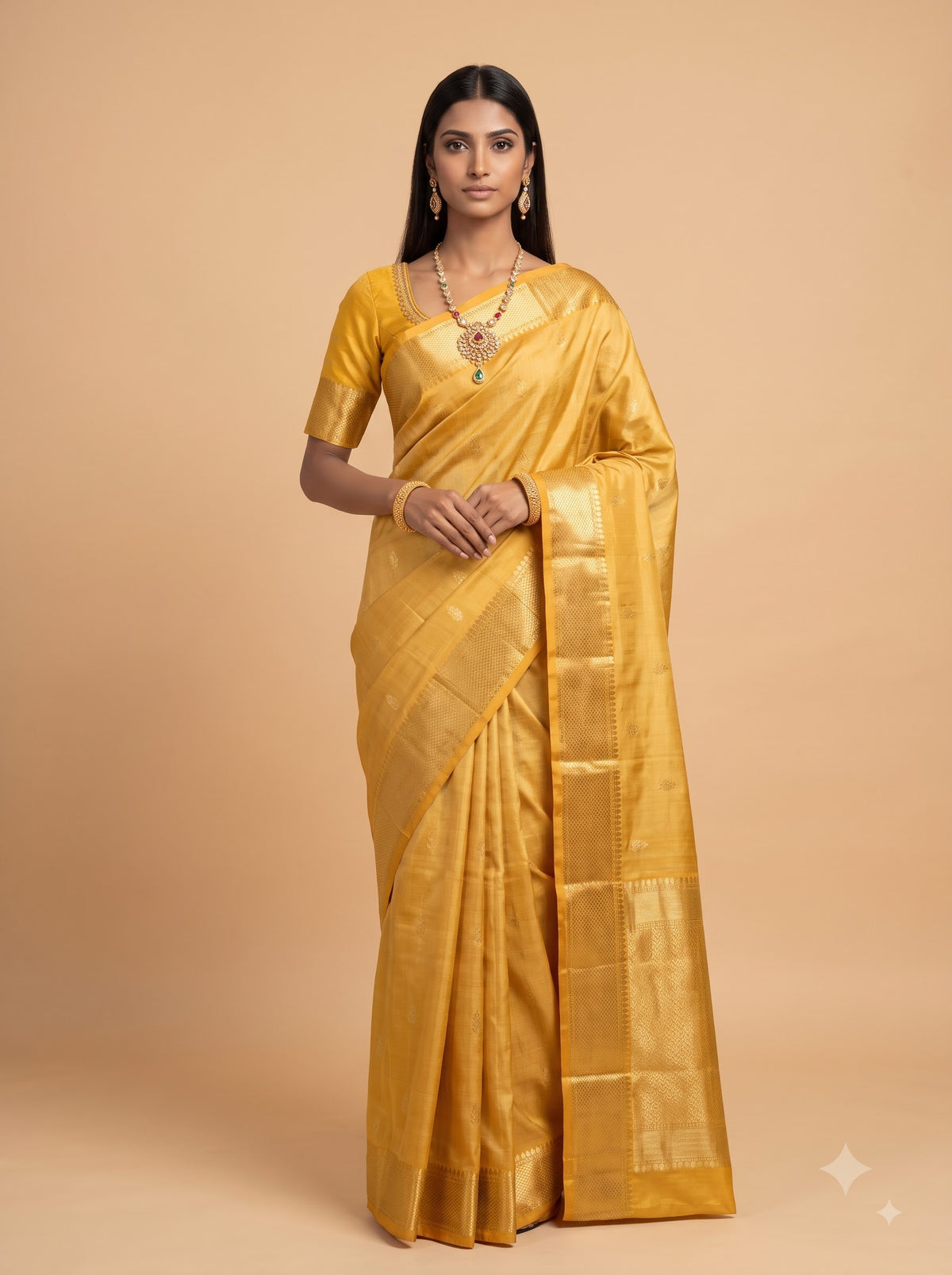
Color: Yellow | Origin: Chanderi Silk (Madhya Pradesh)
Now, the goddess carries her son Skanda in her arms and the tone seems to shift towards the tender. The Chanderi silk, a blend of silk and cotton, is incredibly light and is known to develop its own unique golden shade as it's worn. This particular example has small yellow 'buti' patterns in it. It is perhaps the most frivolous piece of fabric listed here, but then again, this is a goddess devoted entirely to parenthood.
Day 6 — Maa Katyayani, The Slayer of Evil

Color: Green | Origin: Patola Silk (Gujarat)
For Katyayani, one of the fiercest warriors in the Devi Mahaya pantheon, nothing seemed more appropriate than the exquisite Patola weave — a rare one indeed, as it comes only from Gujarat and has to be made by a family of master weavers. Because Patola is woven with exceptional precision, the warp and weft must be dyed before weaving, which allows for no errors in the pattern. In both the goddess and the fabric, there seems not to be room for weakness, or failure. Indeed Katyayani's very name means 'full of grace and strength'.
Day 7 — Maa Kalaratri, Destroyer of Darkness
Color: Grey / Charcoal | Origin: Tussar / Kosa Silk (Chhattisgarh)
Perhaps the most frightening of all avatars, Kalaratri is also one of the most popular, especially among those who follow the tantric traditions. A naturally wild, unbleached silk from Chhattisgarh, Tussar has a certain 'roughness' to it, both in the texture and the sheen (as compared to more refined Tussars). Again, this is a silk that does not seek shine, or attention, which is what Kalaratri herself represents.
Day 8 — Maa Mahagauri, The Pure & Serene
Color: Purple / Violet | Origin: Tanchoi Silk (Varanasi)
After the violent energy of Kalaratri, Mahagauri represents another world of serenity, purity and peace. While Katarani was the natural choice of choice for the first day, Tanchoi seems to be the weave for Day 8. Traditionally these sarees have a purple base with tanchoi embroidery, with the pattern coming from special satin float that are woven into the cloth — not on top, but into the weave itself. This could also symbolise the purity and simplicity of the goddess. Perhaps the most intriguing thing about Tanchoi is that it is machine-spun and woven, yet it demands incredible precision in craftsmanship all the same.
Day 9 — Maa Siddhidatri, Bestower of Perfection
Color: Peacock Green / Teal | Origin: Baluchari Silk (West Bengal)
The last avatar completes the first, hence the name Siddhidatri — giver of all perfections. It makes perfect sense to turn to Baluchari sarees for the last day, as the traditional Baluchi weaving of West Bengal uses pictorial pallus and borders for the narration of Hindu mythology. In many ways it could be seen as the culmination of the nine days — and a fine end in and of itself, since the Baluchari style of weaving is also incredibly intricate and painstaking.
https://www.instagram.com/mugdhabangalore2.0/reel/Dd2eemxlPWf/
A Closing Thread
Nine goddesses, nine days, and nine weaves, from nine completely different regions of India, with their own significance and origins. The arrival of Navratri is a reminder that while all of us are busy having fun and enjoying ourselves, it is a good time to look back at the history and spirituality behind every day. It is also a way for us to learn to appreciate Indian sarees. And the closer we look, the more we can see that this same dedication has been reflected in both the fabrics and the designs used. And this is something that Mugdha hopes her users will do after discovering the tale behind the sarees.


